Semiconductor Fabrication Project
A university cleanroom microfabrication run, taken from a paper mask layout to a patterned silicon wafer. Three mask layers, photolithography, separate gold and titanium etches, resist strip, and an optical microscope check at every stage.
- Substrate
- Silicon wafer
- Process
- Photolithography
- Steps
- Mask · etch · strip
- Inspection
- Optical microscope
From dish to die array
Two images of the same finished wafer: the full surface in the cleanroom dish, and a macro of the patterned die array.
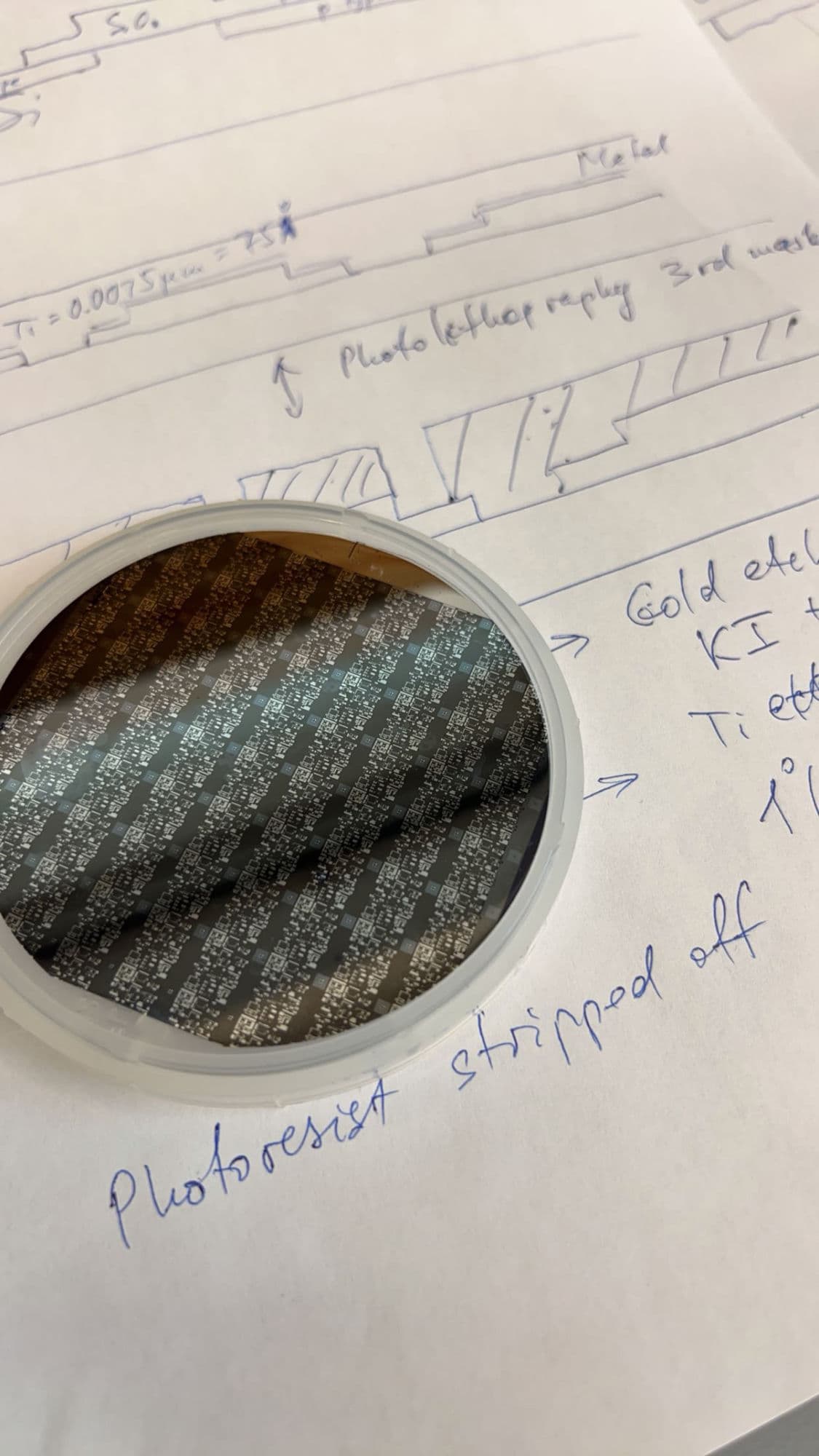
The finished wafer in the cleanroom dish, after photoresist strip. Three mask layers and two etch chemistries are already on the surface.
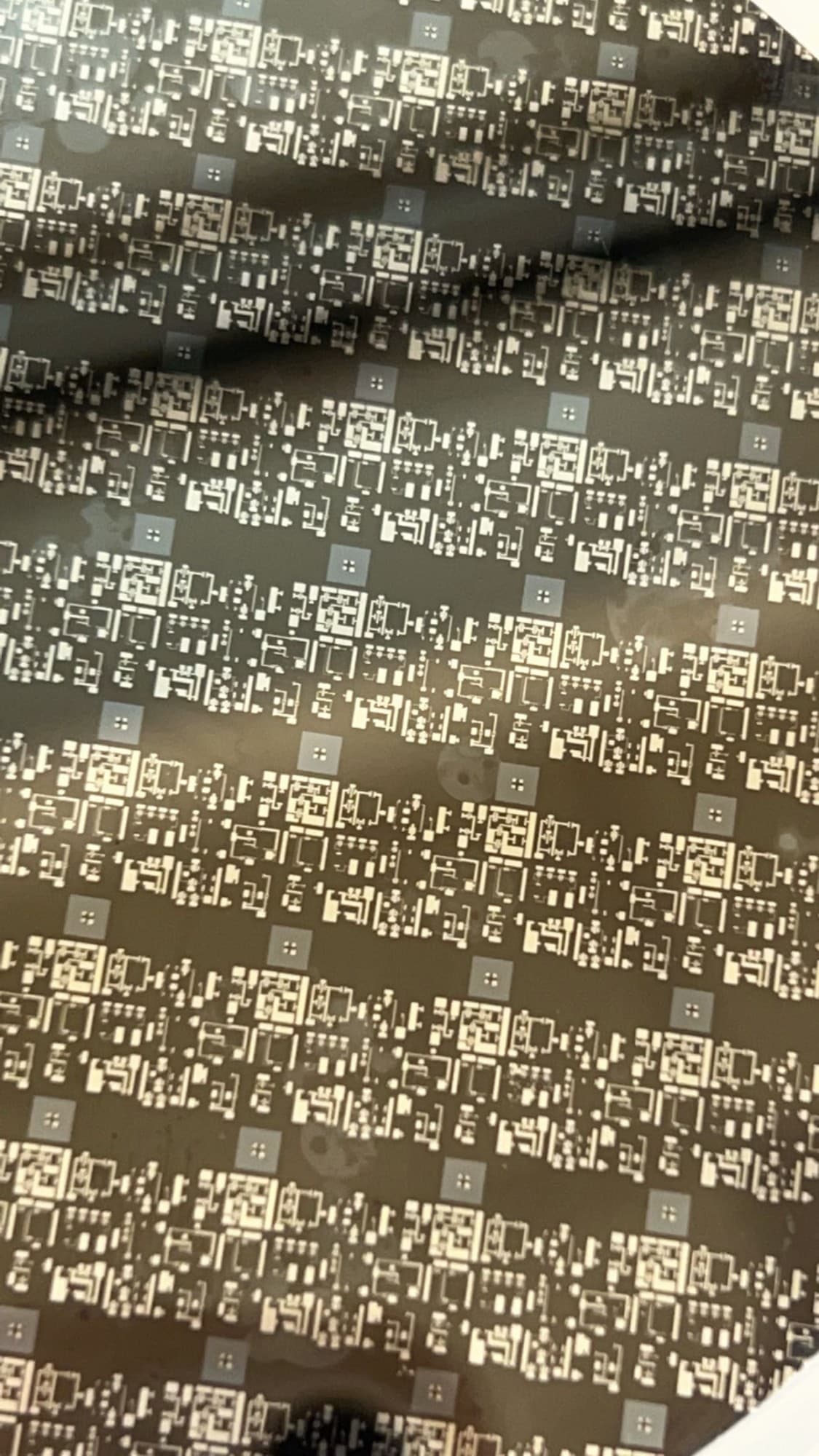
The same wafer at microscope-grade magnification. Each repeating block is one die; the small four-dot squares are mask alignment marks.
Six steps, one finished wafer
Mask, expose, etch, strip, inspect, document. Each step confirmed under the microscope before moving on.
Mask design
Each layer of the device starts as a drawing: black where the silicon should stay covered, clear where it should be exposed. Three masks, drawn and aligned by hand, define every feature on the wafer.
Photolithography
The wafer is coated with photoresist, the mask is laid over it, and ultraviolet light is shone through. Wherever light reaches the resist, the resist hardens; everywhere else it stays soft and washes away.
Etching
Wet and dry etches remove the metal that the soft resist no longer protects. KI-based gold etch and a separate titanium etch each handle the layer they're tuned for, leaving sharp edges where the mask drew them.
Resist strip
Once the metal is patterned, the remaining hardened resist is stripped off with a solvent. What's left on the wafer is the finished metal pattern — exactly the shape the mask called for.
Inspection
Every wafer is photographed under an optical microscope at each stage. Bridges between features, missed edges, and resist residue are caught early enough to redo a step instead of scrapping the whole run.
Documentation
Each mask layer, each etch chemistry, each measured feature dimension is logged step by step. The end product is the wafer and the recipe to make another like it.
The non-obvious parts
Microfabrication looks like a recipe. These six decisions are the difference between following a recipe and producing a wafer that comes out clean.
Three-mask alignment
Every mask after the first has to land on the layer beneath it within a few microns. The alignment marks (the small four-dot crosses visible at every die boundary) are the reference each new mask is registered against.
Etch selectivity
Gold and titanium each need a chemistry that attacks them and leaves the other layer alone. Picking and timing each etch is the difference between a clean line edge and an undercut feature.
Resist coverage in tight features
Photoresist must coat the whole wafer evenly, including the smallest features in the array. A single thin spot turns into an unwanted etch hole that corrupts every die in that band.
Strip without lifting metal
Removing the hardened resist after etch can also pull off freshly patterned metal if the bond to the wafer is weak. Strip chemistry and bake conditions are tuned to leave the metal stuck and the resist gone.
Catching the failure mode at the right step
An optical microscope check after every step makes a defect traceable to the step that caused it. That's the difference between a 30-minute fix and a one-week investigation across a six-step flow.
Documentation that survives the run
Process flow notes, photographed in the case-study image alongside the wafer, are the bridge between this run and the next one. Without them, the result is a one-off; with them, it's a recipe.
Need custom hardware designed?
From cleanroom microfabrication processes like this to full board-level products, scoped, designed, and shipped by one engineer.